
Las Vegas City Directory Shelves
The located Las Vegas city directory material is a set of useful runs, not one uninterrupted series. UNLV Microforms holds four reels of Nevada Territorial volumes published by Research Publications for 1861 through 1882. Those reels are broad Nevada context, so they should not be treated as a continuous Las Vegas run. UNLV Regional History Files, finding aid MS-00809, separately lists a Las Vegas directory item for 1969 in box 12. FamilySearch catalog entries surface local issues for 1934, 1937-38, 1954, 1957, and 1959, with access to an image depending on the item and account rights.
Use the collection record before assuming a missing year was never printed. The local finding aids do not establish the first Las Vegas directory, the last printed directory, or a continuous publisher sequence. Cahlan, UNLV, the Library District, and the FamilySearch catalog are the practical places to ask about a particular year or a reverse volume.
| Collection | Years located | Where held | Access route |
|---|---|---|---|
| Nevada Territorial directory reels | 1861-1882 | UNLV Microforms | Four reels; Nevada-wide context |
| Las Vegas directory file | 1969 listed | UNLV Regional History Files, MS-00809 box 12 | Open finding-aid research; verify the volume onsite |
| FamilySearch city and business directories | Local issues: 1934, 1937-38, 1954, 1957, 1959 | FamilySearch catalog and partner images | Catalog and image rights vary by issue |
| Phonebooks and possible reverse volumes | Exact local run not located | Cahlan, UNLV, Library District, FamilySearch | Ask for the volume, publisher, and address index |
For a modern parcel question, the historical shelf is only one layer. The Las Vegas by-street records route uses current Assessor and Recorder tools, while a historical volume can supply a dated household lead.
Cahlan's Las Vegas Directory Room
The Cahlan Research Library is a key in-person stop for Las Vegas telephone books, high-school yearbooks, newspapers and microfilm, maps, ephemera, manuscripts, and local publications. It offers free public reference use, requires an appointment, and keeps its materials noncirculating. The library is at 309 S. Valley View Boulevard and is listed as open Thursday through Monday, 9:00 a.m. to 4:00 p.m. A focused request works best: give the surname variants, street, approximate years, and whether an address directory, telephone book, obituary card, or yearbook is wanted.
Cahlan's research-library page shows the local-history setting and its appointment-based access.

That physical access matters because a Las Vegas directory, map, or newspaper index may exist on a shelf or microfilm even when no searchable web image is available. Ask staff whether a finding-aid date describes the whole box or only selected folders, and whether photography or scanning is allowed.
Cahlan's card indexes are also a strong companion to a historical volume. They cover the Las Vegas Review-Journal roughly from 1930 to August 1968 and the Las Vegas Age from 1905 to 1940. A notice can supply a date, relationship, or street reference, but it remains a lead that needs another record for confirmation.
Las Vegas Directory Issues Online
UNLV's territorial-directory record describes a collection that can include residents, occupations, residences, heads of families, firms, officials, street directories, churches, schools, organizations, banks, and advertising. Its publisher is identified as Research Publications, and its four reels cover the territorial period. That scope can help with Nevada surname and civic context, but it does not make every reel a Las Vegas household list.
The UNLV Microforms collection record is the source for the territorial-directory screenshot.
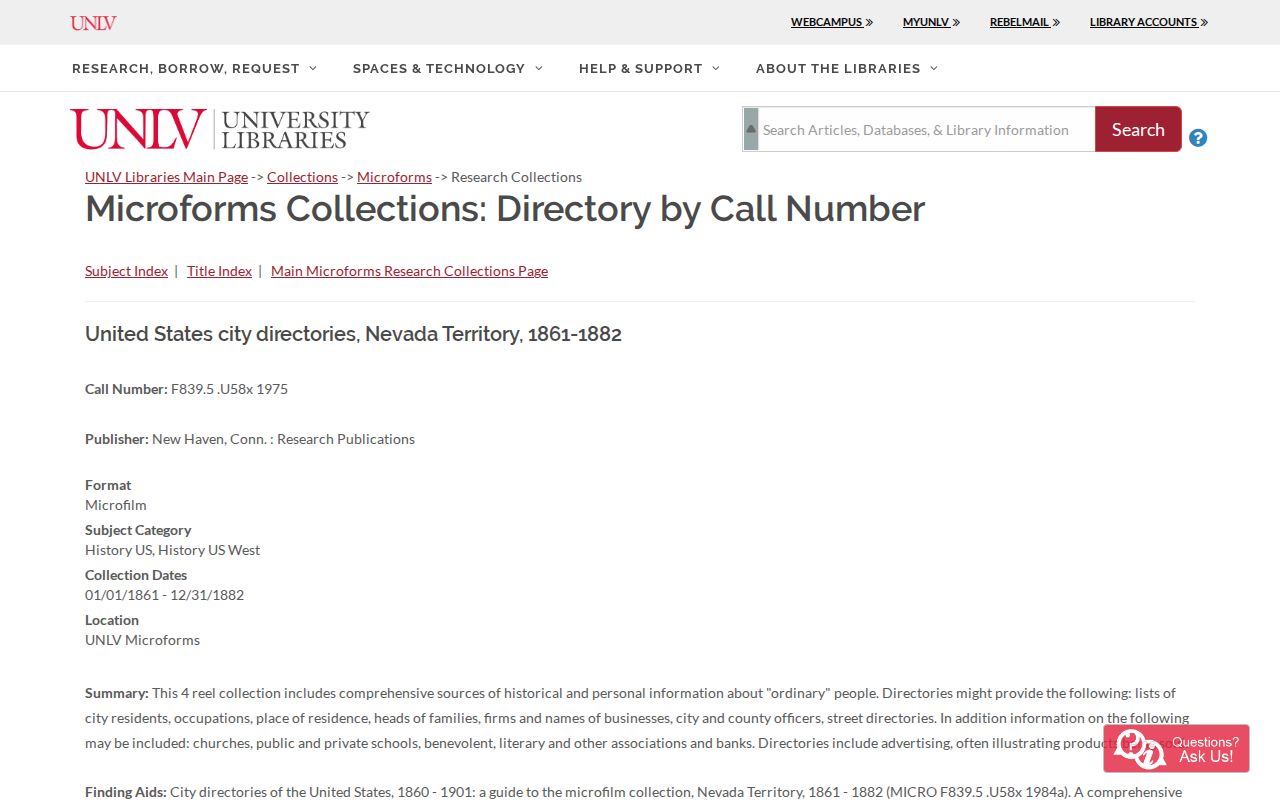
The collection image supports a cautious search plan: record the catalog title and reel details first, then verify whether a relevant Las Vegas page or neighborhood reference appears in that specific volume. It does not establish an unbroken local directory sequence.
FamilySearch's city and business directory collection can add indexed name, residence, occupation, business, or household-context fields when an issue has been imaged and indexed. Search Las Vegas, Clark County, Boulder City, North Las Vegas, and known neighborhood variants separately. The catalog supports filters for place, keywords, titles, author, subjects, surnames, call number, film or image group number, and availability.
How Las Vegas Directory Entries Read
Read a Las Vegas directory entry as a transcription task. The public collection descriptions identify name, residence or address, occupation, head-of-family context, firm or business, official, street-directory, and organization categories. A local individual page was not exposed in the inspected text sources, so do not invent the meaning of a mark from another city or publisher. Copy what the exact volume prints, including initials, punctuation, apartment numbers, and any cross-reference.
| Name | Surname plus given name or initial, copied exactly for later variant searches. |
|---|---|
| Household clue | A spouse, widow or widower note, or other printed parenthetical detail, when present. |
| Occupation or firm | A dated identity clue that can distinguish people with the same name. |
| Residence | Street address, unit, or telephone-book detail as printed in that issue. |
| Marks and references | Ownership or occupancy marks, continuation notes, and abbreviations only when the volume defines them. |
- Criss-cross directory
- An address-arranged volume that can lead from a street address to a printed name, if that edition includes such a section.
- Householder index
- A directory arrangement centered on the household head or listed person, rather than a parcel owner.
- Abbreviation key
- The front-matter list that explains the exact publisher's short forms. Photograph or transcribe it from the same volume.
Note: A printed residence is a date-specific lead, not a finding that the person owned the parcel or remained there throughout the year.
Las Vegas Directory Keys and Streets
A historical directory becomes more useful when its street information is checked against local records geography. UNLV's Regional History Files include Las Vegas streets for 1913-1971 and street names for 1930-1968. Their related files cover businesses, city officials, City Hall, Chamber materials, and local associations. These ranges belong to archival holdings, so the finding aid is an invitation to ask for a box or folder, not a promise that every listed year is digitized.
For a changed or confusing address, use the indexed 1957-1961 R.L. Polk Official Arrow city map and the Las Vegas Sanborn references. The Arrow map includes Las Vegas, Henderson, North Las Vegas, and Boulder City. Sanborn references for January 1928, March 1943, and May 1953 can help place a building footprint, street name, number, or lot. Neither source names every occupant.
Tracing Las Vegas City Directories
Use nearby directory years to test a household trail, not to make a single-entry conclusion. Start by resolving the current or historical address through the map and Assessor material, then preserve every street spelling and number variant. If a confirmed reverse or criss-cross volume supports address lookup, record the exact entry before switching to the alphabetical portion. The next and prior available issues may show a move, an added spouse clue, or a different business link.
- Locate the surname or address in the closest available Las Vegas directory and copy the entry exactly.
- Check the same year in its other arrangement only when the volume contains that arrangement.
- Compare the earlier and later available issues, allowing for skipped publication years and changed street numbers.
- Pair the result with released 1910-1950 federal census schedules, which record a household on the enumeration date.
- Use a deed, parcel, obituary, cemetery, or probate record to test a move, death, ownership change, or estate transition.
Federal census geography may use a township, precinct, or unincorporated district instead of the modern Las Vegas label. Compare spouse, middle initial, occupation, age, parcel, and address before deciding two similar names are the same person. An entry can describe an occupant, caretaker, business, or former owner.
Note: A directory and census can describe one household differently because their dates, address formats, and enumeration purposes are not the same.
Las Vegas Directory Years Located
The located material gives several reliable checkpoints, but also clear gaps. Keeping a simple timeline prevents a researcher from treating a catalog date as a continuous run or a web index as a complete archive.
| 1861-1882 | Nevada Territorial directory volumes appear on four UNLV Microforms reels. |
|---|---|
| 1905-1947 | Las Vegas Age material can supply notices and address context; Cahlan's card index covers roughly 1905-1940. |
| 1934-1959 | FamilySearch or partner entries surface several local telephone and city-directory issues, with access varying by item. |
| 1969 | UNLV Regional History Files explicitly lists a Las Vegas directory item in box 12. |
Las Vegas Review-Journal microfilm begins at UNLV in 1949, and Las Vegas Sun microfilm begins in 1952. Use those runs for dated notices around a directory appearance or disappearance, not as a substitute for the directory itself.
Las Vegas Directory Leads in Print
Newspaper and yearbook material can strengthen a Las Vegas historical-directory lead when it is used carefully. The Las Vegas Age has online page images through the Library of Congress and a cataloged run from 1905 to 1947. UNLV and Cahlan also hold local newspaper, yearbook, map, and microfilm material. Search a surname with a street, spouse, cemetery, school, or neighborhood term, then save the publication date and wording for comparison.
For an older resident, an obituary may suggest relatives, a last address, or a death period. A yearbook can help distinguish a classmate with the same name. Neither is a certified vital record, and no single public alumni roster was located. The strongest result comes from matching the dated notice to the directory, then testing it against a parcel, court, vital, or probate source that is open for the request.
Las Vegas Directory Access Gaps
Some historical Las Vegas records have a physical fallback rather than a web search. The City Archives & Records Center has microfilm rolls for building and business permits back to 1929, cemetery-related material back to 1941, and mixed-subject files back to 1947, but the city's capital plan notes that obsolete equipment and digitization needs make some holdings inaccessible to the public. Ask what is viewable onsite, what staff can retrieve, and whether an identifiable public-record request can yield a public portion.
When the online trail ends, state the gap plainly. Ask Cahlan or UNLV for the exact book, telephone volume, street file, map, or newspaper reel; ask the Clark County Recorder or Assessor only when the question shifts to a parcel or recorded document. A blank city-directory search may mean the edition, spelling, jurisdiction, or access channel is wrong. It does not settle a person's history by itself.
Note: A catalog entry confirms a holding, not a searchable scan, full run, or the presence of a particular Las Vegas address.